Released on Your Own Recognizance? Why the Type of Release Matters for Cuban Adjustment Act Eligibility
Corona Law Firm, P.A. | Immigration Law
Many Cubans who enter the United States without inspection are released from immigration custody with paperwork in hand. That paperwork can look like permission to stay, but a recent decision from the U.S. Court of Appeals for the Eleventh Circuit shows that the label on a release document can decide whether a person qualifies for permanent residence under the Cuban Adjustment Act (CAA).
What the Court Decided
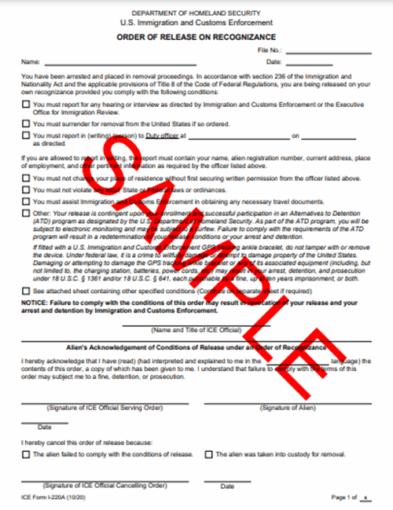
In Aguiar-Fernandez v. U.S. Attorney General, a Cuban family entered the country near the Arizona border in 2021. Border officers detained them briefly and released them under Forms I-220A, which cited 8 U.S.C. § 1226 as the basis for release. The family later sought adjustment of status under the CAA and argued that their release was, as a matter of law, humanitarian parole under § 1182(d)(5)(A).
The court disagreed. It held that a person who entered without inspection must have been “paroled into the United States” under the humanitarian parole provision to qualify under the CAA. Release on conditional parole under § 1226(a) does not meet that requirement. The court adopted the same reading that several other federal circuits have applied to the general adjustment statute, 8 U.S.C. § 1255(a).
The court also addressed how to decide whether humanitarian parole was granted. That question is one of historical fact, answered by the record, including the agency’s stated reason for release. The family’s argument that the type of detention authority the government used automatically meant humanitarian parole was rejected. In this case, the record showed the family was never granted humanitarian parole. They received no I-94 card, which humanitarian parolees usually receive, and DHS denied their later request for humanitarian parole.
The court also upheld the denial of asylum, withholding of removal, and protection under the Convention Against Torture. The family’s fear of future harm was not supported by the record, and the past incidents they described did not amount to persecution.
Why This Matters for Cubans in South Florida
This is a published decision, so it binds federal courts and immigration courts in the Eleventh Circuit, which covers Florida, Georgia, and Alabama. For many Cuban families in Miami and throughout South Florida, the outcome may depend on details that are easy to overlook:
- The release document. An I-220A or other paper describing “release on recognizance” or “conditional parole” is not, by itself, humanitarian parole.
- The I-94 record. Humanitarian parolees normally receive an I-94 card. Its absence is evidence the court weighed.
- Later DHS decisions. A denied request for humanitarian parole can be strong evidence that parole was never granted.
What You Should Do
If you or a family member entered without inspection and were released from custody, do not assume eligibility for the CAA based on a release form alone. Gather every document from your encounter with immigration authorities, including detention papers, notices to appear, I-94 records, and any parole paperwork. Those records can show what kind of release you actually received.
This post is for general educational purposes only and does not constitute legal advice. Reading it does not create an attorney-client relationship. Every case depends on its own facts. To discuss your situation, contact Corona Law Firm, P.A., at 6700 SW 38th Street, Miami, FL 33155.